How to Write a Resume for Freshers: Step‑by‑Step Guide With Example
Writing a resume as a fresher can feel intimidating. Many students and fresh graduates worry because they do not have job experience and are unsure what recruiters actually expect. The good news is that a fresher resume is not about experience—it is about potential, clarity, and presentation.
In this step‑by‑step guide, you will learn how to write a strong resume for freshers, what sections to include, how to present your skills and education, and common mistakes you should avoid. Whether you are a recent graduate or applying for your first job, this guide will help you create a resume that feels confident, professional, and genuine
Table of Contents
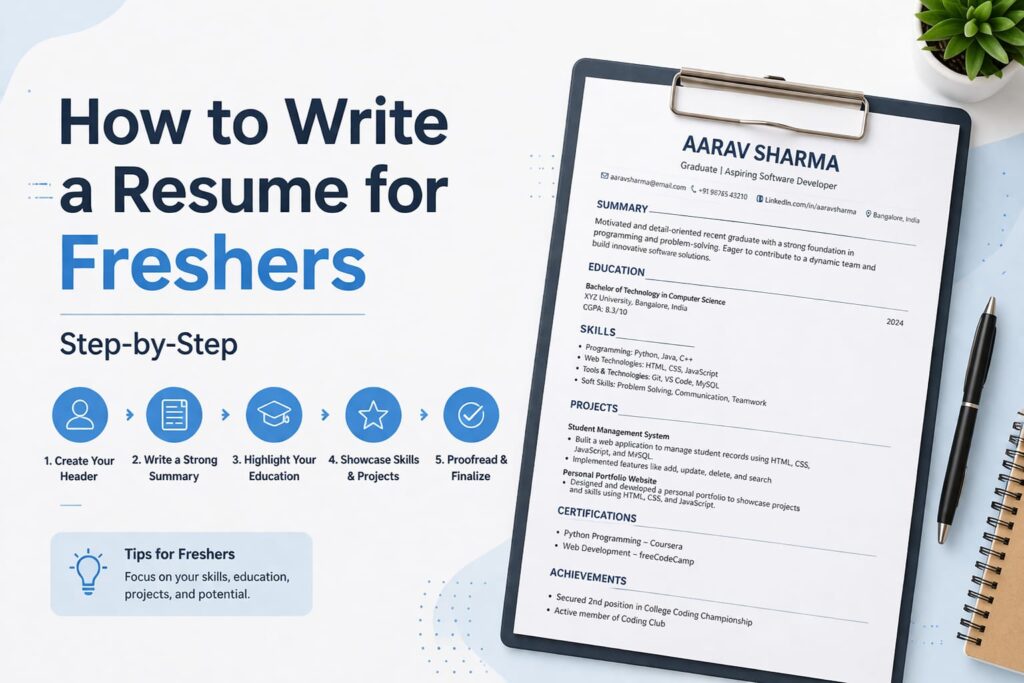
Why Resume Writing Matters for Freshers
Your resume is often the first and only opportunity to create an impression on a recruiter. Most recruiters spend less than 10 seconds scanning one resume. If your resume is unclear, poorly structured, or generic, it may get rejected—even if you’re capable.
A well‑written fresher resume:
- Shows your seriousness toward your career
- Highlights your strengths without exaggeration
- Makes it easy for recruiters to understand your profile
- Improves your chances of getting interview calls
Step 1: Choose the Right Resume Format
For freshers, the chronological resume format works best. This format focuses on education, skills, and training rather than work experience.
Basic Resume Formatting Rules
- Resume length: 1 page only
- Font: Arial, Calibri, or Times New Roman
- Font size: 10.5–11.5 for content, 13–14 for headings
- Text color: Black
- Background: White
- File format: PDF (recommended)
Avoid fancy designs, graphics, icons, or multiple colors. Simple resumes perform better with ATS (Applicant Tracking Systems)
Step 2: Write a Clean Resume Header
Your resume header should be simple and professional.
What to Include
- Full name
- Mobile number
- Professional email address
- City and state
- LinkedIn profile (optional but valuable)
Example
Rahul S
Bangalore, Karnataka
Mobile: 9XXXXXXXXX
Email: rahul.s@email.com
LinkedIn: linkedin.com/in/rahuls
Step 3: Write a Strong Career Objective
The career objective is one of the most important sections for freshers. It explains who you are, what role you are looking for, and what you bring to the table.
How to Write a Good Objective
- Keep it 2–3 lines
- Mention the job role or field
- Highlight relevant skills or education
- Avoid vague statements
Example
“Motivated graduate seeking an entry‑level position where I can apply my technical knowledge, learn from industry professionals, and contribute to organizational growth.”
This sounds natural, honest, and focused.
Step 4: Highlight Your Education Clearly
Education is the strongest section in a fresher resume, so present it clearly.
How to List Education
- Degree name
- College or university name
- Duration or year of passing
- CGPA or percentage (if decent)
Example
Bachelor of Science (Life Sciences)
XYZ University, India
2021 – 2024
CGPA: 8.1
Always list education in reverse chronological order (latest first).
Step 5: Add a Relevant Skills Section
Instead of listing random skills, focus on skills relevant to the job you’re applying for.
Types of Skills to Include
- Technical or domain skills
- Software or tools
- Soft skills
Example
Technical Skills:
• Basics of Clinical Data Management
• Microsoft Excel and Word
• Data validation concepts
• Understanding of EDC systems

Soft Skills:
• Attention to detail
• Good communication
• Time management
• Teamwork
Important: Never list skills you don’t actually possess.
Step 6: Include Training, Internships, or Courses
If you’ve completed any training, internship, or certification, this section adds strong value.
What to Mention
- Training or course name
- Institute or organization
- Duration
- What you learned (3–4 bullet points)
Example
Clinical Research Training
ABC Institute, Bangalore
Duration: 3 Months

• Learned basics of clinical trials and data management
• Understood CRF and eCRF concepts
• Gained exposure to data cleaning and validation
Even short‑term courses are worth mentioning if they are relevant.
Step 7: Add Academic or Practical Projects
Projects show that you have applied your knowledge, even if only academically.
Example
Academic Project: Resume Screening System

• Designed a basic resume sorting model based on keywords
• Studied importance of ATS‑friendly resumes
• Improved understanding of recruitment processes
Keep project descriptions short and outcome‑focused.
Step 8: Mention Certifications (Optional)
Certifications are optional but add credibility.
Example
- Certification in Clinical Research
- ICH‑GCP Certification
- Excel for Beginners Certificate
Only mention genuine certifications.
Step 9: Declaration (Optional)
This section is optional but still commonly used in India.
Example
“I hereby declare that the above information is true to the best of my knowledge.”
Common Resume Mistakes Freshers Should Avoid
- Writing fake work experience
- Using copied content from the internet
- Including irrelevant personal details
- Making the resume more than one page
- Using decorative fonts or colors
- Skipping proofreading
A resume with spelling or grammar mistakes can create a bad impression.
Final Resume Writing Tips for Freshers
- Customize your resume for each job application
- Use keywords from the job description
- Keep sentences short and simple
- Be honest—recruiters can spot exaggeration
- Save your resume with a professional file name
Example:
Rahul_S_Fresher_Resume.pdf
🔗 Explore Latest Opening:
- Syneos Health Hiring Safety & PV Intern/Trainee
- IQVIA Hiring Associate Trainee Clinical Data Coordinator
- Pharmacovigilance Internship at Viginovix
- Latest Pharma jobs for fresher
📚 Career Guide
- Best career option after B.pharm
- Clinical Research Roadmap for fresher
- Pharmacovigilance Roadmap step by step guide
Frequently Asked Questions (FAQ) on Resume Writing for Freshers
1. What is the best resume format for freshers?
The best resume format for freshers is a simple chronological format that highlights education, skills, training, and projects. Since freshers usually do not have work experience, this format helps recruiters focus on academic background and potential rather than job history.
2. How long should a fresher resume be?
A fresher resume should ideally be one page only. Recruiters prefer short and clear resumes that are easy to scan. A one‑page resume also works best with Applicant Tracking Systems (ATS).
3. Can I write a resume without any work experience?
Yes, absolutely. Freshers can write a strong resume by focusing on:
Education
Skills
Training or internships
Academic projects
Certifications
Employers understand that freshers are just starting their careers.
4. What should I write in the career objective as a fresher?
A career objective should clearly mention:
The role or field you are interested in
Your educational background
Your willingness to learn and grow
Keep it short (2–3 lines) and avoid generic statements.
5. Are projects important in a fresher resume?
Yes, projects are very important for freshers. Academic and training projects show that you have practical understanding of your subject and can apply theoretical knowledge in real situations.
6. Should freshers add skills even if they are beginners?
Yes. Freshers should list basic and relevant skills they genuinely know. You do not need to be an expert—basic knowledge and willingness to learn are more important for entry‑level roles.
7. Is it necessary to add certifications in a fresher resume?
Certifications are not mandatory, but they add value if they are relevant to the job role. Short‑term courses, online certifications, and training programs can strengthen your resume.
8. What common mistakes should freshers avoid in resumes?
Freshers should avoid:
Writing fake experience
Copy‑pasting resume content from the internet
Using casual language or email IDs
Adding irrelevant personal details
Making the resume longer than one page
9. Should I customize my resume for different jobs?
Yes. Customizing your resume for each job application greatly improves your chances of selection. Use keywords from the job description and highlight skills that match the role.
10. In which format should I send my resume?
The best format to send your resume is PDF. It maintains formatting across devices and looks professional. Also, use a clear file name like:YourName_Fresher_Resume.pdf