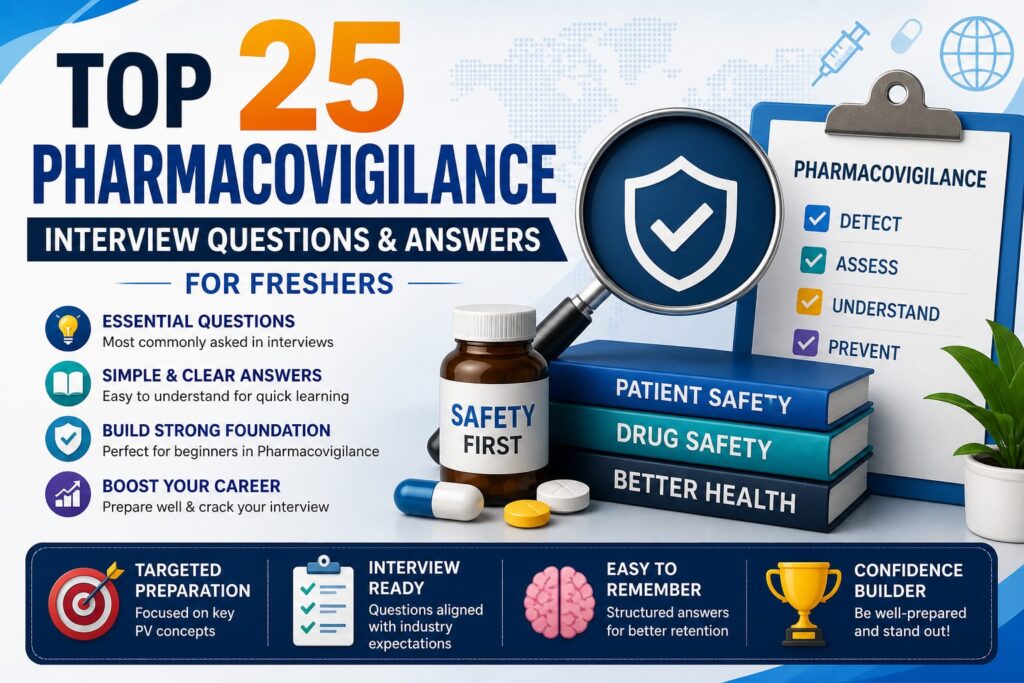
Top 25 Pharmacovigilance Interview Questions and Answers for Freshers
Pharmacovigilance has become a fast‑growing and rewarding career option for pharmacy and life‑science graduates. Freshers preparing for interviews often struggle to understand what kind of questions are asked and how much depth is expected in answers.
This article covers the top 25 Pharmacovigilance interview questions for freshers, explained in simple, clear, and beginner‑friendly language. Whether you are preparing for your first interview or looking to strengthen your basics, this guide will help you build confidence.
1. What is Pharmacovigilance?
Pharmacovigilance is the science and activity related to the detection, assessment, understanding, and prevention of adverse effects or any other drug‑related problems. The primary goal of pharmacovigilance is to ensure patient safety and promote the safe use of medicines throughout their lifecycle.
2. Why is Pharmacovigilance important?
Pharmacovigilance is important because it helps:
- Identify unknown or rare adverse drug reactions
- Protect patient safety
- Ensure regulatory compliance
- Support benefit–risk evaluation of medicines
Without pharmacovigilance, unsafe medicines could remain on the market longer than acceptable.
3. What is an Adverse Event (AE)?
An Adverse Event is any untoward medical occurrence in a patient who has received a pharmaceutical product, regardless of whether it is related to the drug.
4. What is a Serious Adverse Event (SAE)?
A Serious Adverse Event is an adverse event that results in outcomes such as:
- Death
- Life‑threatening condition
- Hospitalization or prolonged hospitalization
- Disability or congenital anomaly
SAEs require expedited reporting.
5. What is an ICSR?
An Individual Case Safety Report (ICSR) is a detailed record of an adverse event associated with a medicinal product. It is submitted to regulatory authorities to monitor drug safety.
6. What are the minimum criteria for a valid ICSR?
A valid ICSR must contain:
- An identifiable patient
- An identifiable reporter
- A suspect drug
- An adverse event
7. What is the role of Pharmacovigilance in drug safety?
Pharmacovigilance monitors drug safety during clinical trials and after market approval, ensuring early detection of risks and supporting regulatory decision‑making.
8. Difference between AE and ADR?
- AE (Adverse Event): Any medical occurrence
- ADR (Adverse Drug Reaction): An adverse event that is suspected to be related to the drug
ADR implies a causal relationship; AE does not.
9. What is MedDRA?
MedDRA (Medical Dictionary for Regulatory Activities) is a standardized medical terminology used for coding adverse events and medical conditions consistently across clinical trials and post‑marketing reports.
10. What is coding in Pharmacovigilance?
Coding is the process of assigning appropriate MedDRA terms to reported adverse events to ensure standardized reporting and data analysis.
11. What is narrative writing in Pharmacovigilance?
Narrative writing is a structured summary of a safety case that describes the patient, event, suspect drug, timeline, and outcome in a clear and chronological manner.
12. What is case processing?
Case processing involves receiving, reviewing, entering, coding, and submitting adverse event information into a safety database while ensuring accuracy and compliance.
13. What is follow‑up in Pharmacovigilance?
Follow‑up refers to the process of obtaining additional safety information from reporters when initial data is incomplete or unclear.
14. What is duplicate case checking?
Duplicate checking ensures that the same adverse event is not reported multiple times, which could distort safety data.
15. What is Argus Safety?
Argus Safety is a widely used pharmacovigilance safety database used for case processing, tracking, and regulatory reporting.
16. What is expedited reporting?
Expedited reporting refers to fast‑track submission of serious and unexpected adverse events within strict regulatory timelines.
17. What is pharmacovigilance compliance?
Compliance refers to adhering to regulatory requirements, SOPs, timelines, and documentation standards set by global health authorities.
18. What is signal detection?
Signal detection is the process of identifying potential new safety risks by analyzing reported adverse event data.
19. What is post‑marketing surveillance?
Post‑marketing surveillance monitors the safety of drugs after approval, when used by a wider population.
20. What are global regulatory authorities in Pharmacovigilance?
Common regulatory authorities include:
- US FDA
- EMA
- MHRA
- CDSCO
- Health Canada
21. Why do companies hire freshers in Pharmacovigilance?
Freshers are hired because:
- The field requires process‑driven training
- Skills can be developed on the job
- There is growing global demand
22. What skills are required for a Pharmacovigilance fresher?
Key skills include:
- Attention to detail
- Good communication
- Basic medical knowledge
- Documentation skills
- Willingness to learn
23. Is Pharmacovigilance a good career option?
Yes. Pharmacovigilance offers:
- Strong global demand
- Stable career growth
- Remote work opportunities
- Meaningful impact on patient safety
24. What are entry‑level roles in Pharmacovigilance?
Common entry‑level roles:
- Drug Safety Associate
- Pharmacovigilance Associate
- Junior Safety Analyst
25. How can freshers prepare for Pharmacovigilance interviews?
Freshers should:
- Understand basic PV concepts
- Learn MedDRA and ICSR lifecycle
- Practice interview answers clearly
- Gain basic knowledge of safety databases
✅ Final Thoughts
Pharmacovigilance is a promising career for freshers willing to learn and grow in a regulated healthcare environment. Mastering these top 25 Pharmacovigilance interview questions will help you build strong fundamentals and perform confidently in interviews.
Explore opportunities for Pharma fresher in PV domain
Pharma jobs for experienced candidates
Medpace is hiring for the role of Drug Safety Specialist
📢 Get Daily Pharma Job Alerts
Join our Telegram channel for instant updates on pharma, government & fresher jobs.
Join Telegram Now